
SKUAST-K prepares roadmap to revive J&K's silk industry
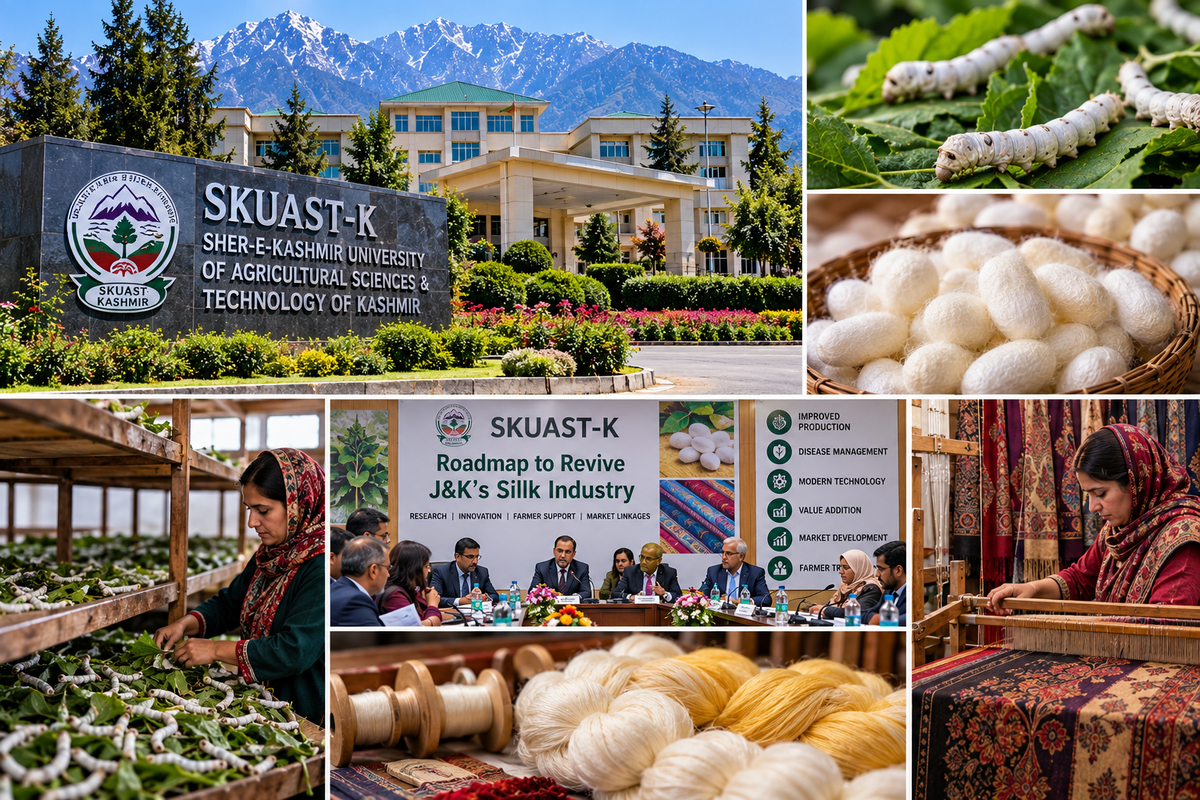
Srinagar, Jammu and Kashmir | October 15, 2026
Sher-e-Kashmir University of Agricultural Sciences and Technology of Kashmir (SKUAST-K) is working towards developing a roadmap to revive Jammu and Kashmir’s traditional silk industry, with a focus on strengthening sericulture, improving productivity and creating new livelihood opportunities for farmers and rural communities.
The initiative aims to address challenges affecting the region’s silk sector and explore ways to make silk production more competitive, sustainable and economically viable. Sericulture, which involves rearing silkworms for silk production, has historically played an important role in Jammu and Kashmir’s rural economy, supporting farmers, silkworm rearers, reelers, weavers and other workers involved in the production chain.
The proposed roadmap is expected to bring together scientific research, improved farming practices, technological innovation and stronger links between producers and markets.
Strengthening Sericulture Through Scientific Research
Sericulture offers significant opportunities for rural employment, particularly in areas where agricultural activities provide the primary source of income. However, productivity can be affected by factors such as the quality of mulberry plantations, silkworm diseases, changing climatic conditions, limited access to modern techniques and fluctuations in market demand.
SKUAST-K’s research expertise could help address these issues through improved silkworm-rearing practices, disease management, better mulberry cultivation and the development of quality silk cocoons.
Scientific interventions can help farmers improve production efficiency while reducing losses during silkworm rearing. Training programmes and field demonstrations could also enable traditional producers to adopt modern techniques without losing the region’s established sericulture practices.
Creating Employment and Supporting Rural Livelihoods
The revival of the silk industry could benefit several sections of Jammu and Kashmir’s rural economy. Farmers involved in mulberry cultivation and silkworm rearing could gain from improved productivity, while reelers, artisans and small-scale enterprises could benefit from a more reliable supply of quality raw silk.
The sector also has potential to generate employment for young people and women through silkworm rearing, silk processing, weaving, handicraft production and marketing.
Developing stronger links between farmers, research institutions, government departments and private businesses will be important to ensure that improvements in production translate into better incomes for local communities.
Improving Quality and Market Competitiveness
For Jammu and Kashmir’s silk industry to become more competitive, improving the quality and consistency of silk products will be essential. Better processing facilities, modern reeling technology, quality testing and effective marketing could help local producers reach wider markets.
There is also scope to promote the region’s traditional silk products by highlighting their craftsmanship, cultural heritage and quality. Stronger branding and access to digital marketplaces could help small producers connect with customers beyond the Union Territory.
However, achieving these objectives will require coordinated investment, technical support and suitable market infrastructure.
A Sustainable Future for Kashmir’s Silk Sector
The proposed roadmap represents an opportunity to combine traditional skills with scientific research and modern business practices. Its success will depend on practical implementation, sustained institutional support and the participation of farmers and industry stakeholders.
By strengthening sericulture and encouraging value addition, Jammu and Kashmir could improve rural incomes, preserve traditional occupations and create new opportunities across the silk production chain.
The initiative also highlights the importance of agricultural universities in supporting regional industries through research, innovation and skill development. If effectively implemented, the roadmap could contribute to the long-term revival of the region’s silk industry and reinforce its position as an important part of Jammu and Kashmir’s economic and cultural heritage.
Source: Sher-e-Kashmir University of Agricultural Sciences and Technology of Kashmir (SKUAST-K) and regional business news coverage.
Published by: Tawi Observer


